
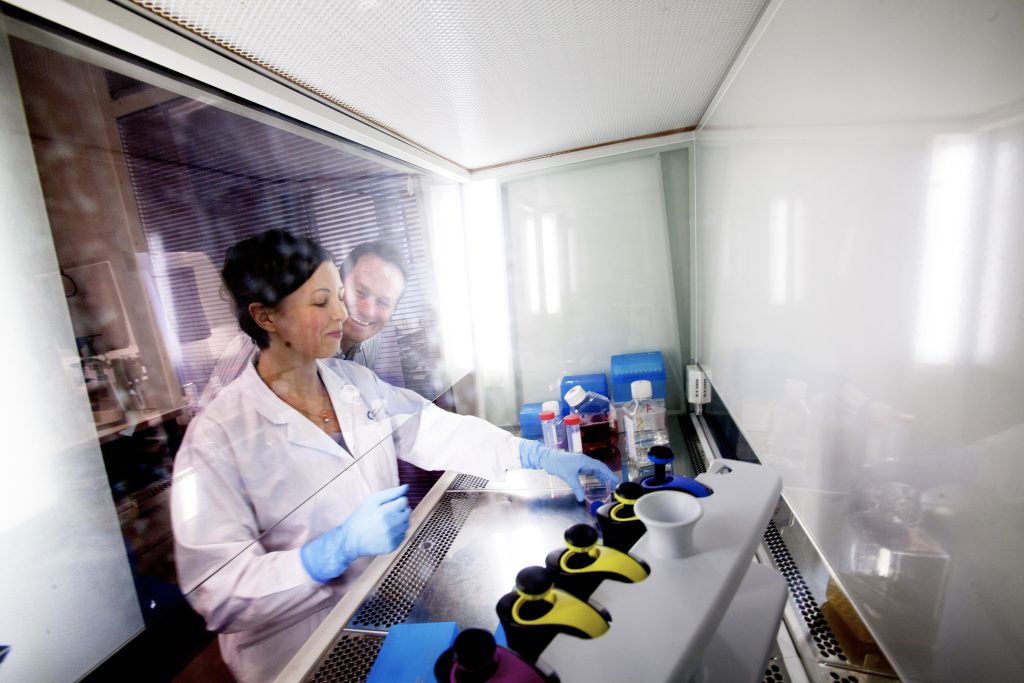
Researcher, dr. Anastassia Serguienko made the initial discovery that now has developed into a very exciting project, and even attracted considerable funding without published data. More in Norwegian: Les mer om prosjektet og pionerutlysningen på kreftforeningens sider.

Forlaget gir stor omtale, som blir krysspublisert av mange medisinske og vitenskapelige nettsider, blant andre:

Comment by EurekAlert/AAAS: «Unsuspected discovery of abnormal antibodies could explain paediatric cancer«

Oppdatert omtale på nettsiden til Barnekreftforeningen, vår hovedsponsor:
«Forskningsmidler fra Barnekreftforeningen har ført til oppsiktsvekkende funn»

Oppmerksomhet i Norge: Forsiden i Bergens Tidende, med stort oppslag der og i Aftenposten. Artikkel på forskning.no


Interview with Newsweek:
«Scientists Find Unusual Pattern in Children Later Diagnosed With Cancer»

Interview med Primary News
«A new study in Frontiers in Immunology found that autoantibodies against DNA repair proteins are shared by cancer patients and by healthy children who were later diagnosed with cancer years afterward. This opens a new angle on pediatric cancer etiology, beyond the classical genetic-mutation view.»
Read the full post on LinkedIn.

SIOP made a special «New Scientific Discovery session» where we could for the first time convey our hypothesis to the scientific community. See abstract (search for Serguienko).

Kreftforeningen var tidlig ute med et «Pionerstipend» til vår «high-risk, high-gain»-prosjekt

Trond Mohns Forskningsstiftelse ga oss store midler til å utvide kunnskapen om autoantistoffenes epidemiologi, som del av bevilgningen til Centre for translational research in Epidemiology (TRACE).

For 6 years we have pursued the surprising discovery made while using human proteome microarrays to profile autoantibodies in sarcoma patients, that children with various types of cancer have many autoantibodies against DNA repair proteins. These proteins resemble typical tumour suppressor proteins involved in hereditary cancer syndromes, but are not significantly mutated in pediatric cancers, thus they are not expected to be cancer-associated neoantigens.

This led to our hypothesis that they could be involved in the etiology of cancer. We observed, as others have previously reported, that such antibodies can enter a fraction of live cells and even their nuclei, and thus might inhibit DNA repair and induce mutations.

By analysing autoantibody profiles in serum samples collected at school age in children from the Born in Bradford and ALSPAC cohorts, we found in those 30 who got cancer before 26 years of age a similar enrichment in DNA repair autoantigens that we found in our pediatric cancer patients.

We observe that cells internalizing such antibodies may sequester DNA repair proteins in the cytoplasm, which could prevent their activity in the nucleus, and are pursuing investigations of the influence on DNA repair activity.
We thus propose a new «hallmark of cancer», that autoantibodies of this kind can attenuate or impair DNA repair and lead to initiation of cancer, although it will need more research to prove direct causality.

